pridemobility365
e-commerce


May 2024 – present

Redesigning B2B E-commerce for Authorized Providers & Retailers

Redesigned the PrideMobility 365 B2B platform to improve part discovery, streamline quote and order workflows, reduce checkout errors, and deliver a consistent experience across desktop, tablet, and mobile for high-volume providers and dealers.
My Role

Senior UX/UI Designer

Stakeholders

UX/UI Designer, React Developers, Backend Developer, Business Analyst and Architect

Company

PrideMobility (USA & Canada)

Tools

Figma, FigJam, Adobe Photoshop, Miro, Jira and Confluence

Why a redesign was necessary

Pride Mobility 365 is critical for providers and dealers managing quotes, orders, and parts. However, key workflows were slowing users down and increasing errors.

Core Problems

Understand real-world ordering behavior before redesign

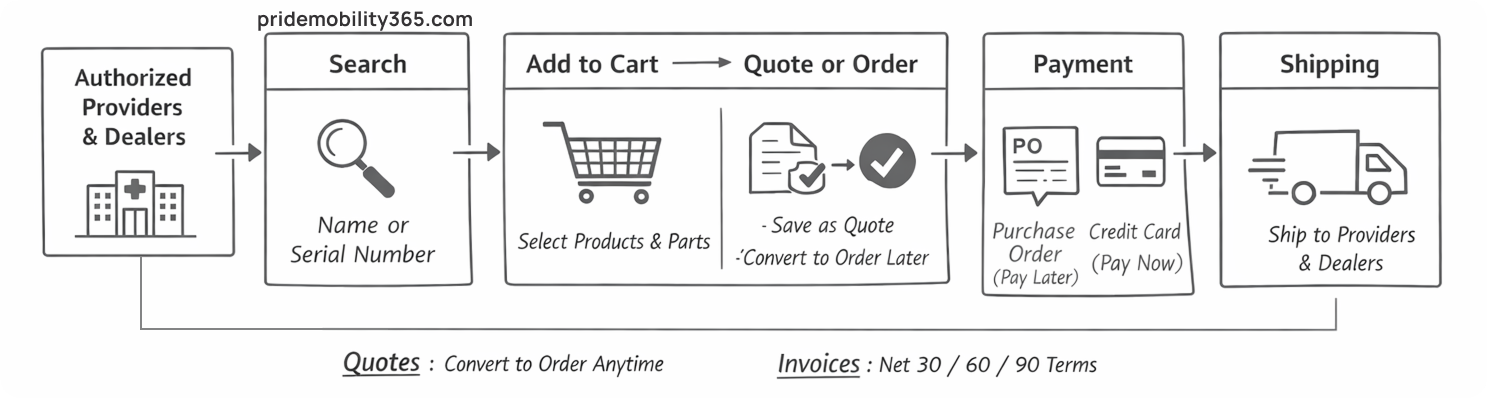
Providers and dealers follow approval-driven purchasing workflows. Most transactions start as quotes and are later converted into orders, while urgent purchases move directly to order placement.

Key Behavioral Insights

How Research Guided Redesign Decisions

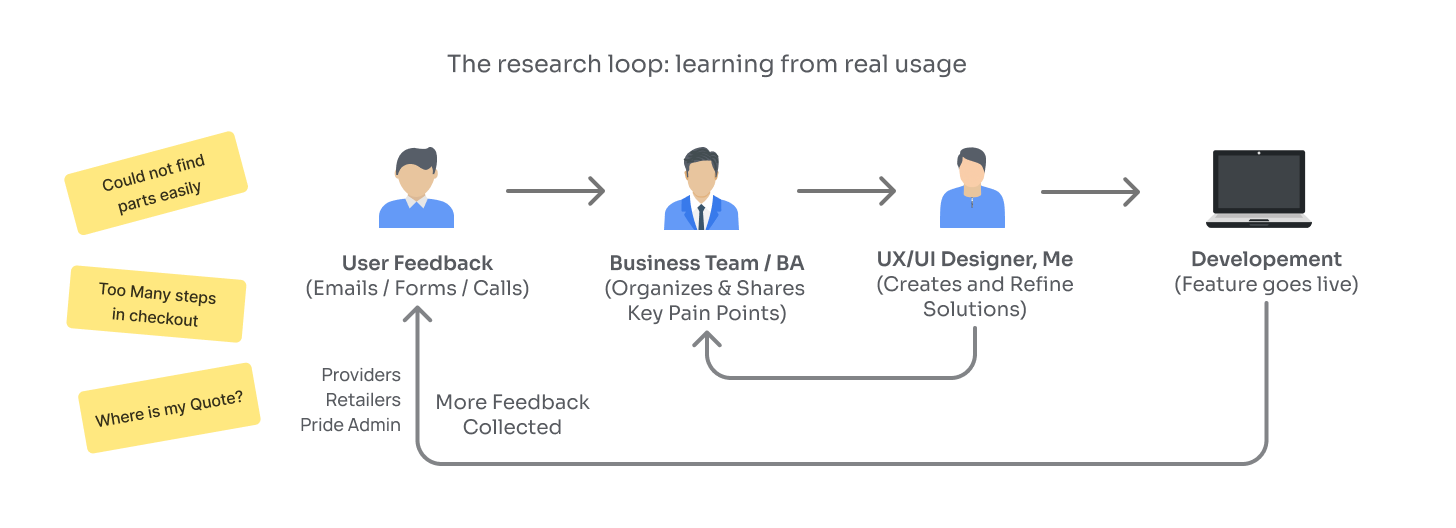
Research combined real usage observation, support feedback, and business workflow reviews. Instead of redesigning the entire platform, improvements focused on high-frequency and high-risk workflows.

Redesign Focus Areas

Decision 1: Improve Discovery - Search by Name & Serial Number

Problem

Providers and dealers struggled to locate correct parts quickly, especially when working with serial numbers and product hierarchies. Search results often required manual verification using documents or support teams.

Decision

Introduce a unified search experience supporting product name search and serial number hierarchy discovery, allowing users to understand parent-child part relationships directly within search results.

Options Considered
  • Improve keyword-only search relevance
  • Guided part discovery flow
  • Serial hierarchy + smart search results (Chosen)
Trade-offs

Introduced a new discovery pattern requiring users to understand part hierarchy structure, but significantly improved accuracy and reduced downstream ordering errors.

User Impact
Faster product and part discovery, Reduced incorrect part selection, Higher confidence before order or quote creation, Reduced dependency on manuals and support

Decision 2: Create Order or Quote Using One Experience

Problem

Users frequently add multiple products and parts to cart before deciding whether to save the cart as a quote or place an order. In the previous experience, quote and order workflows were separated, forcing users to repeat steps or rebuild carts when switching between quote and order, slowing down high-volume B2B workflows.

Decision

Design a cart-driven commitment model where users choose Convert Quote or Convert Order directly from the cart, and complete a shared checkout flow. Both paths use the same address, shipping, and review experience, while payment is required only when placing an order.

Options Considered
  • Clear separation of workflows
  • Quote-first workflow with later order conversion
  • Cart-based intent selection with shared checkout flow (Chosen)
Trade-offs

Payment collection only for orders, Different validation rules for quote vs order, and Different final commitment actions.

User Impact
Users can choose quote or order at the right decision moment - directly from cart, No need to rebuild carts when switching between quote and order, Faster checkout completion using one familiar flow, and Reduced ordering errors through shared validation and review steps.

Decision 3: Unified Checkout for Quote and Order Flows

Problem

Quotes and orders required the same address, shipping, and review steps. Separate checkout experiences would duplicate user effort and increase friction when users needed to switch from quote to order.

Decision

Design a single checkout experience shared by quotes and orders, where payment is conditionally shown only when placing an order, while maintaining the same structure for both flows.

Options Considered
  • Separate checkout flows for quote and order
  • Quote-first checkout with later order conversion
  • Unified checkout with conditional payment logic (Chosen)
Trade-offs

Required more complex checkout logic to dynamically handle payment, validation rules, and final completion actions based on user intent.

User Impact
Users learn one checkout flow, Reduced data re-entry, Faster checkout completion using one familiar flow, Faster quote-to-order transition and Lower checkout error rates

Decision 4: Quote Lifecycle - Manage and Convert Saved Quotes

Problem

Users frequently return to saved quotes to review, modify, or convert them into orders. In the previous experience, quote status, priority, and next actions were difficult to identify quickly, forcing users to open multiple quotes before taking action.

Decision

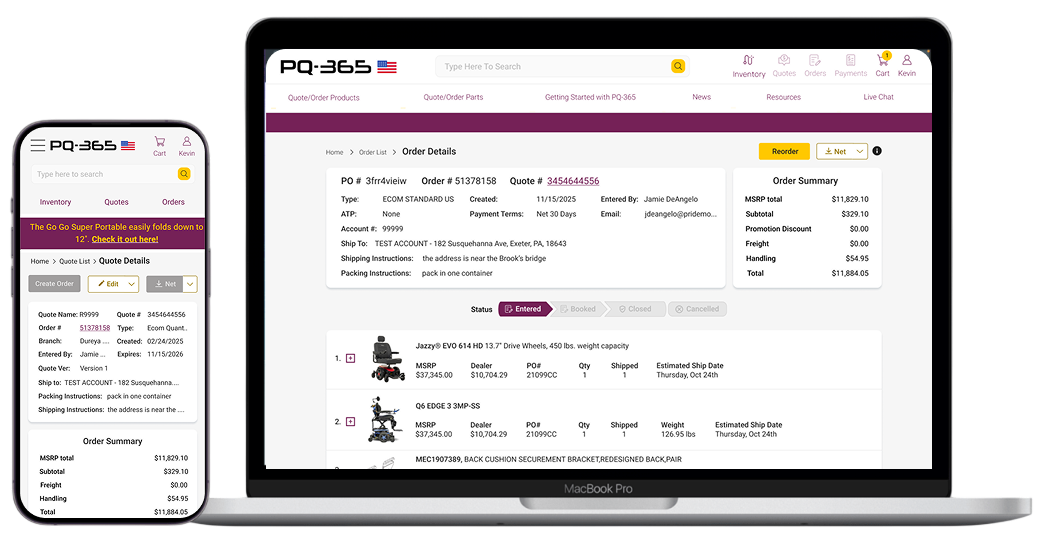
Redesign the quote list and quote details experience to highlight status visibility, quick actions, and clear conversion paths from quote to order.

Options Considered
  • Improve table styling and filtering only
  • Introduce separate dashboard for quote monitoring
  • Action-driven quote list with contextual quote details (Chosen)
Trade-offs

Required redesign of list interaction patterns and status definitions to support quick decision making without overwhelming users with excessive data.

User Impact
Faster quote identification and follow-up, Clear visibility of quote status and progress, Direct quote-to-order conversion from list and Reduced time spent navigating between screens.

Decision 5: Order Lifecycle - Track, Review and Reuse Orders

Problem

After placing orders, users needed to quickly track order status, review order details, and reorder frequently purchased products or parts. In the previous experience, order tracking and follow-up actions required navigating across multiple screens.

Decision

Redesign the order list and order details experience to emphasize status visibility, shipment awareness, and quick reorder actions directly from list and detail views.

Options Considered
  • Improve filtering and sorting within existing order tables
  • Introduce timeline-style order tracking experience
  • Status-driven order list with contextual order details and reorder (Chosen)
Trade-offs

Required clear order status definitions and consistent system messaging to ensure users understood order progress without introducing additional UI complexity.

User Impact
Faster order tracking and status understanding, Improved shipment visibility, Quick reorder capability for repeat purchases and Reduced dependency on support for order updates.

Implementation & Testing

Collaborated closely with developers to ensure accurate Figma-to-code implementation, delivering designs with clear specs, interaction notes, and component guidelines. Participated in weekly UI reviews to refine spacing, responsiveness, and UX alignment. Internal QA used real provider workflows, leading to quick improvements in validation, layout clarity, and step progression across Quote Builder and checkout.

Testing Methods
  • Internal QA sessions
  • UI consistency checks
  • Developer collaboration & review
  • Iterative improvements post-launch

Outcome & Impact

User Experience
  • Faster product and part discovery
  • Reduced errors in quote and order creation
  • More reliable checkout completion
Business & Platform
  • Faster quote-to-order workflows
  • Reduced support dependency for order clarification
  • Consistent experience across desktop, tablet, and mobile
Client & User Feedback

"The new experience makes our job faster—we don’t have to second-guess part numbers or quotes anymore."

The redesign is now actively used across the U.S. and Canada and continues to receive updates based on live feedback from providers and retailers.